
Cranberries
The Floating Berry
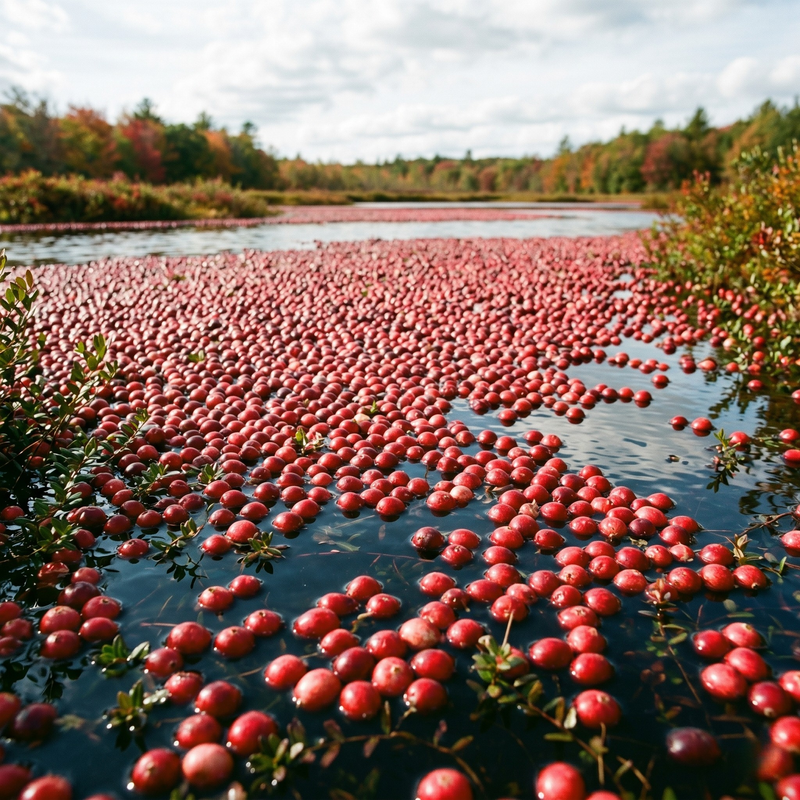
Did you know that cranberry farms are sometimes flooded on purpose?
Cranberries are North America's most dramatic fruit. They grow in wetlands where most crops cannot survive. They are harvested by flooding entire fields, creating one of agriculture's most spectacular visual events. They preserved themselves naturally through benzoic acid long before food science gave that compound a name. And they adapted from a traditional Indigenous food to a global commercial product without losing the bold, distinctive character that makes them unlike any other berry.
Few foods have a story as visually dramatic as the cranberry.
Native to North American bogs and wetlands, cranberries were valued by Indigenous communities for thousands of years before European settlers arrived. They served as food, dye, and medicine—a versatile resource recognized long before commercial agriculture gave them global reach.
Their harvest is unlike any other: bogs flooded with water, berries floating to the surface in vast red fields, harvesters wading through chest-high pools of fruit. It is one of agriculture's most spectacular moments.
Today, dried cranberries are enjoyed worldwide, growing steadily in India as consumers discover their distinctive sweet-tart character and vibrant colour.
Discover Fascinating Facts About Cranberries
Did you know that cranberry farms are sometimes flooded on purpose?
Did you know that cranberries naturally grow in bogs and wetlands?
Did you know that cranberries contain tiny air chambers?
Did you know that Native Americans were using cranberries long before European settlers arrived?
Did you know that cranberries helped people preserve food?
Did you know that not all cranberries are harvested in flooded bogs?
Did you know that cranberries are naturally tart?
Did you know that drying transforms cranberries just as it transforms grapes and plums?
Did you know that cranberries became closely associated with Thanksgiving?
Did you know that cranberry vines stay close to the ground?
Did you know that cranberry bogs are carefully managed ecosystems?
Did you know that cranberries have been growing in North America for thousands of years?
Did you know that cranberries helped inspire one of North America's most beloved food traditions?
Did you know that cranberry growers sometimes refer to the harvest as a "red tide"?
Did you know that cranberries are naturally cholesterol-free?
Did you know that cranberries are enjoyed far beyond North America?
Did you know that cranberry harvest season is one of agriculture's most visually spectacular moments?
Did you know that dried cranberries have become increasingly popular in India?
Did you know that cranberries symbolize adaptation?
Did you know what cranberries are called in different Indian languages?
From North American wetlands to global snack collections, cranberries have always stood apart.
Their story is one of bold identity—a berry that thrives where others cannot, harvests in a way no other crop does, and delivers a flavour profile distinctive enough to be recognized immediately.
More than a dried fruit, the cranberry is a reminder that the most memorable foods are often those that refuse to be ordinary.
Inspired by what you've discovered?
Explore Nut Story Cranberries & Related Products

Trail Mix
Nut Story Heart Health Trail Mix — ❤️ "The Omega-Pulse" | 1600mg Omega-3 per Serving
₹ 599.00 ₹ 569.002 options