
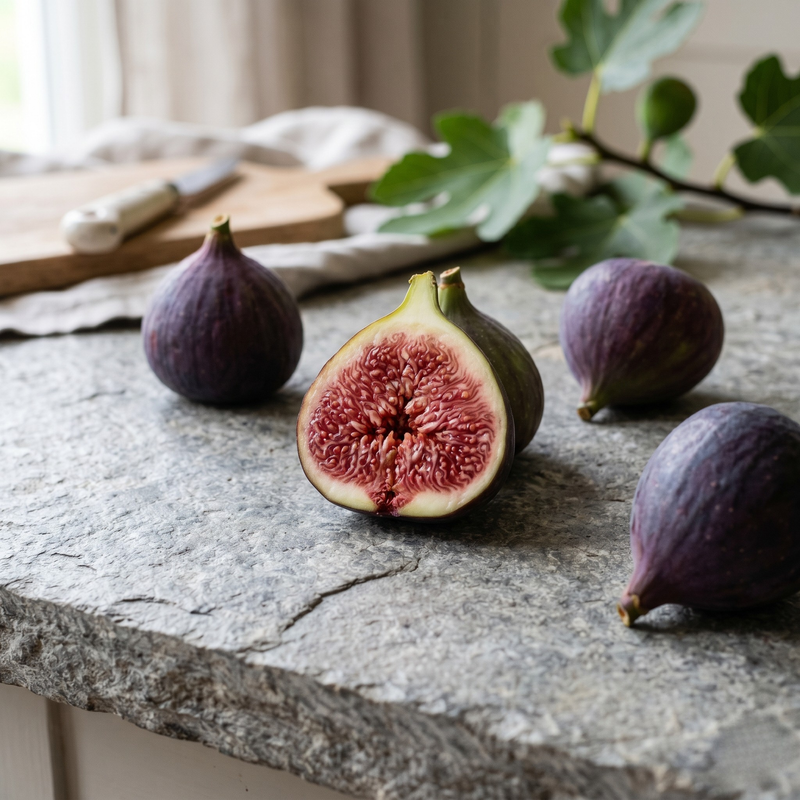
Figs
Nature's Hidden Garden
Did you know that figs are actually flowers turned inside out?
Figs may be the most philosophically interesting fruit in the world. They hide their flowers inside themselves, depend on one of nature's most ancient partnerships for pollination, and carry centuries of sacred symbolism across religions and civilizations. From the Bodhi Tree beneath which the Buddha attained enlightenment, to Cleopatra's royal table, to the everyday Anjeer of Indian kitchens—the fig's story is as layered as its flavour.
The fig may be the world's most philosophically interesting fruit.
It hides its flowers inside itself. It was cultivated before wheat and barley. It appears in the sacred texts of multiple religions. It is associated with the Bodhi Tree under which the Buddha attained enlightenment, with ancient Egyptian royal courts, and with the philosophical gardens of Greece and Rome.
Throughout history, figs have been symbols of abundance, wisdom, and prosperity across cultures that had no contact with each other.
In India, figs (Anjeer) are celebrated both as food and as sacred trees whose spiritual significance stretches back thousands of years.
The fig is not just a fruit. It is a story that spans continents, millennia, and faiths.
Discover Fascinating Facts About Figs
Did you know that figs are actually flowers turned inside out?
Did you know that a tiny wasp helps create many figs?
Did you know that figs are among the oldest cultivated foods in human history?
Did you know that figs appear throughout the history of ancient civilizations?
Did you know that a mature fig tree can produce hundreds of fruits each season?
Did you know that not every fig depends on a wasp?
Did you know that figs were treasured by the ancient Egyptians?
Did you know that figs were prized by the Greeks and Romans?
Did you know that the Bodhi Tree belongs to the fig family?
Did you know that Cleopatra was said to love figs?
Did you know that dried figs helped people preserve fruit before refrigeration existed?
Did you know that figs and fig wasps evolved together over millions of years?
Did you know that figs are naturally sweet because they ripen on the tree?
Did you know that a fig tree can remain productive for decades?
Did you know that figs became symbols of abundance and prosperity?
Did you know that figs are naturally cholesterol-free?
Did you know that figs are enjoyed in both sweet and savoury dishes?
Did you know that India has its own fig-growing traditions?
Did you know that every fig contains hundreds of tiny seeds?
Did you know what figs are called in different Indian languages?
From ancient Egypt to modern Indian kitchens, from sacred Buddhist traditions to Mediterranean cuisine, figs have occupied a unique place in human culture for thousands of years.
Their story reminds us that some foods are more than ingredients—they are connections to our deepest cultural roots.
More than a dry fruit, the fig is a reminder that nature's most extraordinary gifts often come hidden inside plain exteriors, waiting to reveal their sweetness to those patient enough to discover them.