
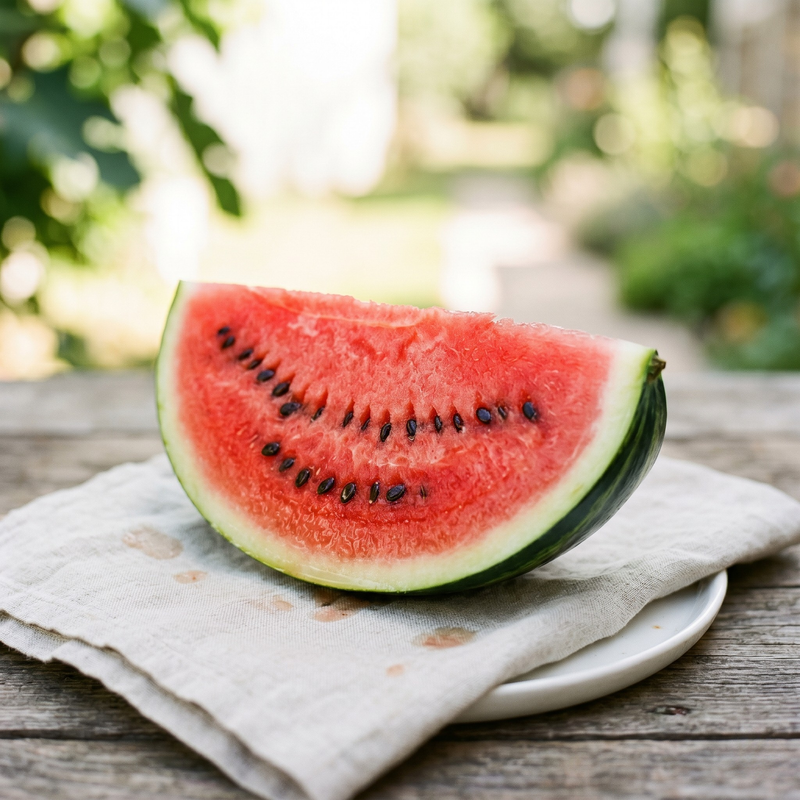
Watermelon Seeds
The Forgotten Seed
Did you know that people have been eating watermelon seeds for thousands of years?
The watermelon seed is one of food's great overlooked stories. Casually discarded at summer picnics across much of the world, yet actively consumed as a traditional snack across Africa, China, and the Middle East. Once valued by ancient Egyptians for their oil content. Carrying the complete genetic blueprint for one of the world's most beloved fruits. The watermelon seed is proof that the most familiar things can still hold secrets worth discovering.
Few seeds have a more ironic story than the watermelon seed.
For much of the world, it is the seed most casually discarded—spit out, flicked aside, or treated as an inconvenience. Yet the same seed has been valued as a food source in Africa for thousands of years, roasted and sold as a snack in China during festivals, and pressed for oil in parts of the ancient Middle East.
The watermelon itself originated in Africa, and the seeds that were once its most valued component have been travelling with the fruit ever since—across ancient trade routes, through the kitchens of pharaohs, to the summer tables of the modern world.
Now, as seed nutrition gains recognition in India, the forgotten seed is quietly finding its moment.
Discover Fascinating Facts About Watermelon Seeds
Did you know that people have been eating watermelon seeds for thousands of years?
Did you know that watermelons originated in Africa?
Did you know that swallowing a watermelon seed will not grow a watermelon inside you?
Did you know that watermelon seeds were once more important than the fruit's flesh?
Did you know that roasted watermelon seeds have been enjoyed across Africa and Asia for centuries?
Did you know that seedless watermelons still need seeds to exist?
Did you know that watermelon seeds were carried across ancient trade routes?
Did you know that some cultures deliberately grow watermelons for their seeds?
Did you know that watermelon seeds are surprisingly efficient travel companions?
Did you know that a single watermelon can contain hundreds of seeds?
Did you know that watermelon belongs to the same family as cucumbers and pumpkins?
Did you know that watermelon seeds helped preserve future harvests?
Did you know that black watermelon seeds and white watermelon seeds are different?
Did you know that watermelon seeds are naturally cholesterol-free?
Did you know that watermelon seeds are enjoyed in many parts of Africa and Asia?
Did you know that watermelons are among the world's most recognized fruits?
Did you know that watermelon seeds symbolize hidden potential?
Did you know that watermelon seeds are becoming increasingly popular in India?
Did you know that every watermelon began as a seed that somebody chose to plant?
Did you know what watermelon seeds are called in different Indian languages?
The watermelon seed's story is ultimately about perspective.
What one culture casually discards, another treasures. What was once a primary food source became an afterthought—and is now being rediscovered. The seed has not changed. Only the attention paid to it has.
More than a seed, the watermelon seed is a reminder that the most overlooked things sometimes carry the most potential—waiting patiently for someone to notice.